Your Flight Got Cancelled: How to Get Your Money Back
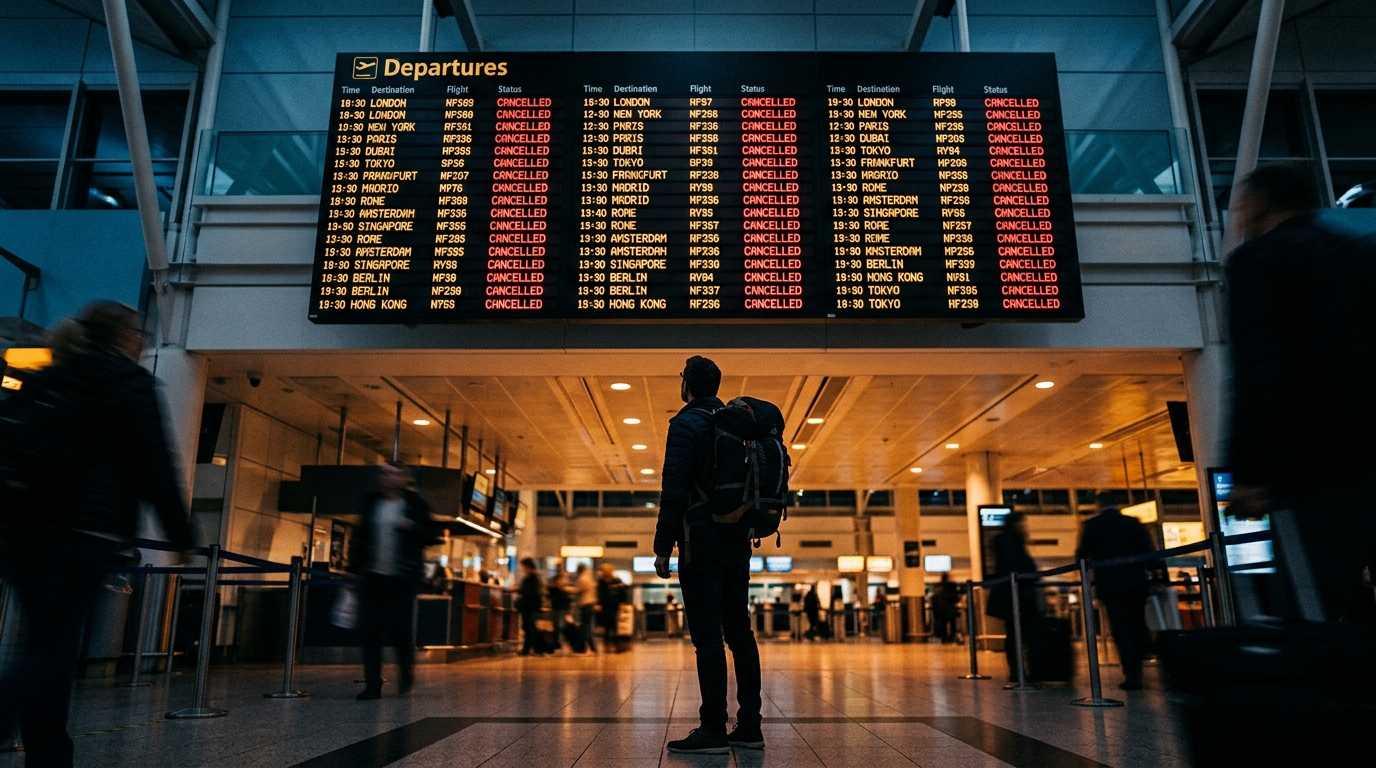
Your flight just got cancelled. The gate agent is swarmed, the rebooking line is 40 people deep, and the airline app is offering you a voucher like that's supposed to fix your ruined schedule. Don't take it. You're owed a cash refund — and depending on where you're flying, you could be owed hundreds of euros on top of that.
Here's exactly what you're entitled to and how to get it, whether you're flying in the US, Europe, or both. All regulations cited below are current as of March 2026.
US flights: airlines must automatically refund you in cash within 7 business days (credit card) — no request needed. EU flights: you get the refund plus up to €600 in compensation on top. Don't accept a voucher. File with the airline first, then escalate to the DOT or a national enforcement body if they stall.
Your Flight Cancellation Refund Rights (US vs EU)
If your flight is cancelled and you choose not to travel, you are entitled to a full cash refund of your ticket — regardless of the reason for the cancellation, and even if you bought a non-refundable ticket. This applies to flights in both the US and EU, but the rules differ significantly in what else you can claim.
We've seen airlines take weeks to process what should be a seven-day refund. Knowing your exact rights — and putting them in writing — is the fastest way to cut through the stalling.
| United States (DOT Rule) | European Union (EU261) | |
|---|---|---|
| Cash refund | Yes — automatic, no request needed | Yes — within 7 days |
| Refund timeline | 7 business days (credit card) / 20 days (other) | 7 days |
| Extra compensation | No federal requirement | €250–€600 depending on distance |
| Meals & hotel | Airline policy (not legally required) | Legally required (meals, hotel, transport) |
| Applies to | Flights to, from, or within the US | Flights from EU, or to EU on EU airline |
| Weather exception | Refund still owed (compensation N/A) | Refund yes, compensation no ("extraordinary circumstances") |
The big difference: in the US, you get your ticket price back. In the EU, you get your ticket price back plus a flat compensation payment based on flight distance — €250, €400, or €600 — unless the airline can prove "extraordinary circumstances" like severe weather or air traffic control decisions. Most eligible passengers never file for this money. According to AirHelp, 68% weren't even informed of their rights during the disruption.
Airlines will push vouchers, credits, and "flexible rebooking" before mentioning your right to cash. Under the 2024 DOT automatic refund rule, US airlines must refund you in the original payment method without you asking. If they offer a voucher first, say no.
The 4-Step Refund Playbook
The fastest way to get your money back after a cancelled flight is a four-step escalation: decline the voucher, file a claim, escalate to a regulator, then chargeback as a last resort.
Most people stop at step one and accept whatever the airline offers. Don't be most people.
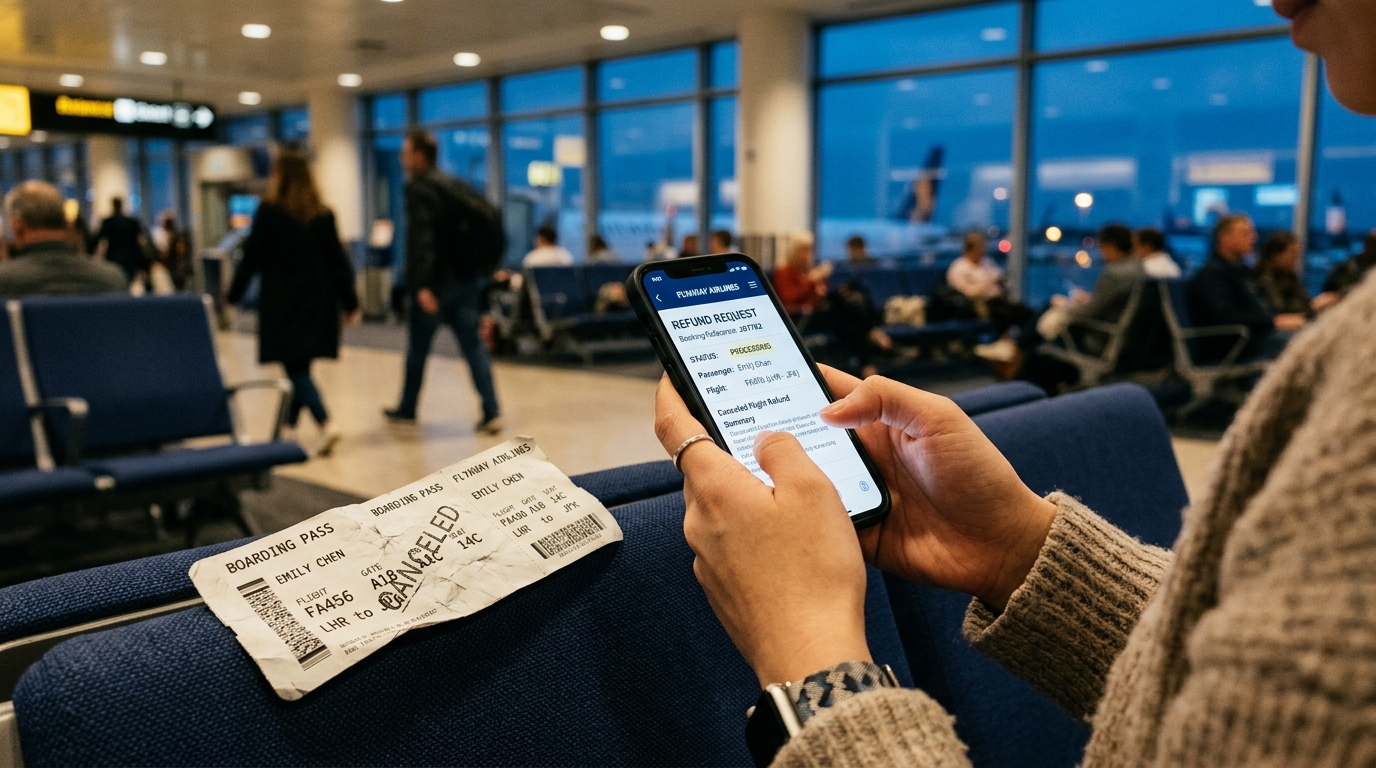
Put it in writing before you leave the gate.
Step 1: Decline the voucher, request a cash refund. At the gate or on the phone, explicitly say "I want a refund to my original payment method." Under the DOT's automatic refund rule, the airline is required to process this automatically — though in practice, you may need to insist. For EU flights, also mention EU261 compensation — this is separate from the refund.
Document everything: screenshot the cancellation notice, save emails, note the names of agents you speak to. If you've already got your travel documents organized digitally, you'll have your booking confirmation and boarding passes ready to attach to any claim — one of those things you don't think about until you're standing at a gate with no proof of your original booking.
Step 2: File through the airline's official claims portal. Most airlines have an online claims form (usually under "customer relations" or "feedback"). For EU261 compensation, you'll need your booking reference, flight number, and a brief description of the disruption. File as soon as possible — airlines are more responsive to claims submitted within the first two weeks.
Step 3: Escalate to the regulator. If the airline ignores you or denies your claim, file a formal complaint. In the US, file through the DOT's consumer protection process (CBS News has a good walkthrough of how it works). In the EU, contact the National Enforcement Body (NEB) in the country where the disruption happened — you can find yours on the EU passenger rights portal. Airlines respond faster when a regulator is involved.
Step 4: Credit card chargeback (last resort). If the airline still hasn't refunded you, file a chargeback with your credit card company. Important: under the Fair Credit Billing Act, you must file within 60 days of the statement date showing the charge — so don't wait. You'll need documentation proving the cancellation and your refund request. This is the nuclear option — use it only after steps 1-3 have failed.
Flying from Europe? You don't have to file the EU261 claim yourself. Services like AirHelp and Skycop handle the paperwork and charge a fee (typically 25–35% as of 2026) only if you win. Worth it if the airline is stonewalling — these services have legal teams and established enforcement processes that individual passengers don't.
Frequently Asked Questions
Do I get a refund if the airline cancels due to weather?
Yes — you always get a ticket refund for a cancelled flight, regardless of the reason. Weather only affects EU261 compensation (the extra €250–€600), which airlines can refuse if they prove "extraordinary circumstances." The refund itself is non-negotiable.
Can I get a refund on a non-refundable ticket?
Yes. "Non-refundable" means you can't cancel for a refund. If the airline cancels, you're owed a full refund regardless of ticket type. This is federal law in the US and EU regulation in Europe.
How long does an airline have to refund me?
In the US: 7 business days for credit card purchases, 20 calendar days for other payment methods. In the EU: 7 days. If they miss these deadlines, file a complaint with the DOT or the relevant EU National Enforcement Body.
What counts as a "significant change" that qualifies for a refund?
Under the 2024 DOT rule: a domestic flight delayed 3+ hours or an international flight delayed 6+ hours. Also: airport changes, added connections, or downgrades to a lower class. Any of these trigger a refund if you choose not to fly.
Should I accept rebooking or take the refund?
If you still need to get there, accept rebooking — but in the EU, you keep your right to €250–€600 compensation even if you fly on a later flight. If the trip is ruined, take the cash refund. Only accept a voucher if it's worth significantly more than cash and you're certain you'll use it.
Sources
- AirHelp 2025 Press Release — US passenger disruption data, compensation awareness statistics
- EU Your Europe — Air Passenger Rights — Official EU261 compensation amounts and rights
- CBS News — DOT Automatic Refund Rule — 2024 DOT rule requirements and "significant change" definitions
- Thrifty Traveler — Credit Card Chargeback Guide — Chargeback process and Fair Credit Billing Act details
- AirHelp — EU261 Explained — Regulation overview and claim process
Key Takeaways
- Always refuse vouchers first — you're legally owed cash back in both the US and EU when an airline cancels your flight.
- EU passengers get more — on top of the refund, EU261 gives you €250–€600 in compensation plus meals and hotel. US law only guarantees the refund.
- Stuck at the airport? Long security lines and delays are a separate problem — see our airport survival guide for tactics to get through faster.
- File fast, document everything — screenshot the cancellation, save boarding passes, note agent names. Airlines are more responsive to claims filed in the first two weeks.
- Escalate in order — airline first, then DOT complaint (US) or National Enforcement Body (EU), then credit card chargeback. Don't skip steps.
- Keep your travel documents, boarding passes, and expense receipts organized in one place — TripProf's document storage keeps everything digital so you have proof ready when you need to file a claim.
Keep Reading
More travel tips and guides picked for you

Solo Travel Burnout: When the Adventure Stops Being Fun
You saved for months and told everyone about this trip. Now you can't get out of bed. Solo travel burnout is real — here's how to spot it, tell it apart from a bad day, and fix it.
The Travel Document Checklist You Actually Need (2026)
Three major travel document rules changed in 2025-2026. REAL ID, ETIAS, UK ETA, passport validity — here's every requirement, deadline, and fee in one checklist.
Your Airport Survival Guide During the TSA Crisis (2026)
TSA lines are hitting 3+ hours at major airports. Here are the specific tools, tactics, and workarounds to get through security without missing your flight — including free shortcuts most travelers don't know about.